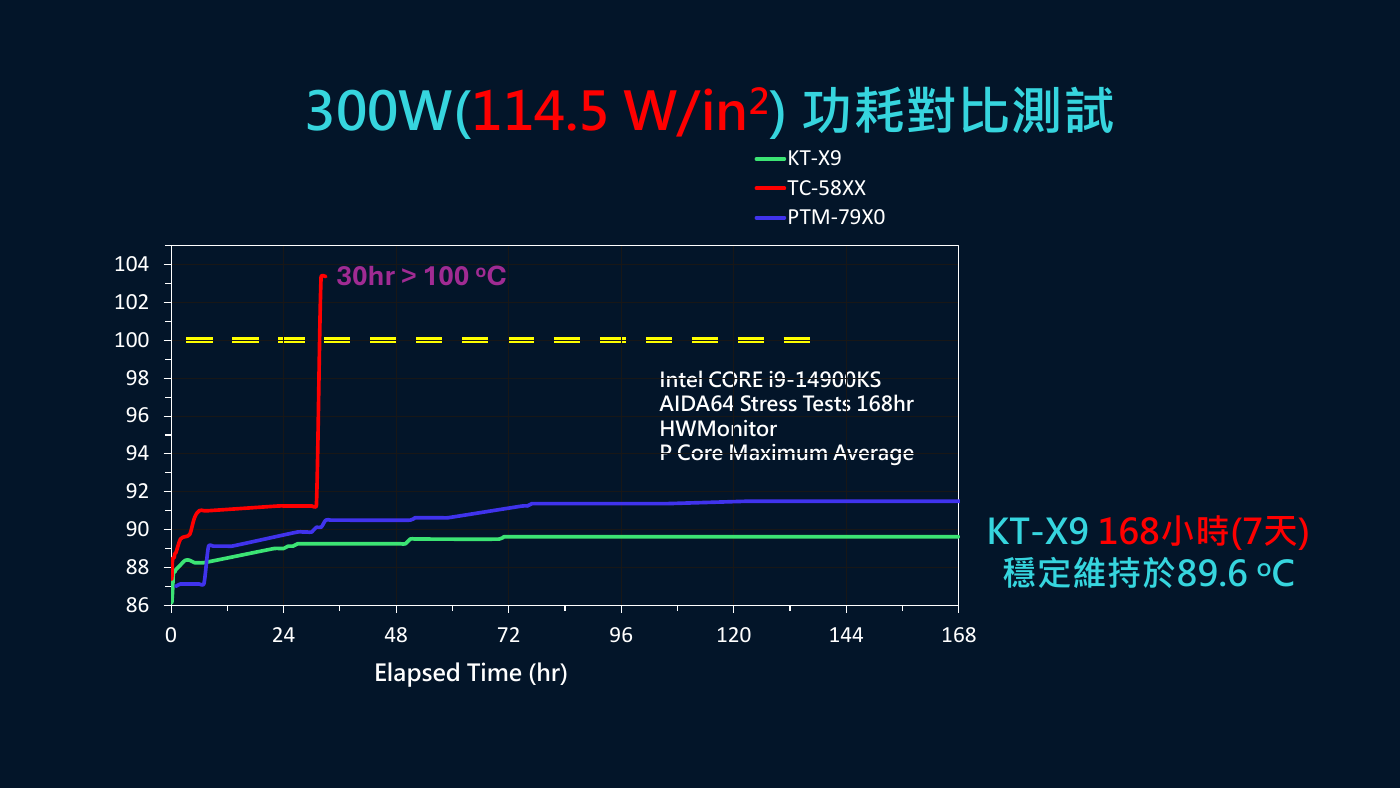
300 W / 168-hour stress test
The source reports a P-core maximum-temperature average of 89.6°C for KT-X9 on an Intel Core i9-14900KS platform running AIDA64.
Platform-specific result; it does not predict temperatures in other cooling systems.
KT-X9 silicone-free thermal grease addresses thermal impedance, application handling and long-term stability in high-power interfaces. InnoChem supports product selection and application discussions.
Material structure study
Select the test pressure to view the reported thermal impedance.
| Property | Value / characteristic | Method / conditions |
|---|---|---|
| Thermal conductivity | 5.5 W/m·K | Hot Disk |
| Thermal impedance | 0.05 K·cm²/W | ASTM D5470 / 40 psi |
| Viscosity | <400,000 cP | Listed as BF CVE #7 in source |
| Stated operating temperature | <110°C | Product presentation specification page |
| Formulation | Silicone-free | As described in supplier product material |
Source: KT-X9 technical presentation (260318), pp. 6, 11 and 15. Page 11 reports 0.05 at 40 psi; page 15 lists a general specification of <0.06. These values are retained in their respective contexts. Actual thermal performance depends on bond-line thickness, pressure, surface condition and system design.
Use reported impedance values to estimate the temperature drop across the interface alone.
Only the two source test pressures are offered; no interpolation is used.
Estimated interface temperature drop ΔT
A simplified one-dimensional steady-state estimate, not a CPU temperature or full-system simulation. Assumes uniform contact and all specified heat flow through the interface; excludes heatsink, ambient, spreading resistance and aging.
Share device power, heatsink contact area, clamping force and thermal cycling range to assess interface impedance and pump-out risk.
The source reports a P-core maximum-temperature average of 89.6°C for KT-X9 on an Intel Core i9-14900KS platform running AIDA64.
Platform-specific result; it does not predict temperatures in other cooling systems.
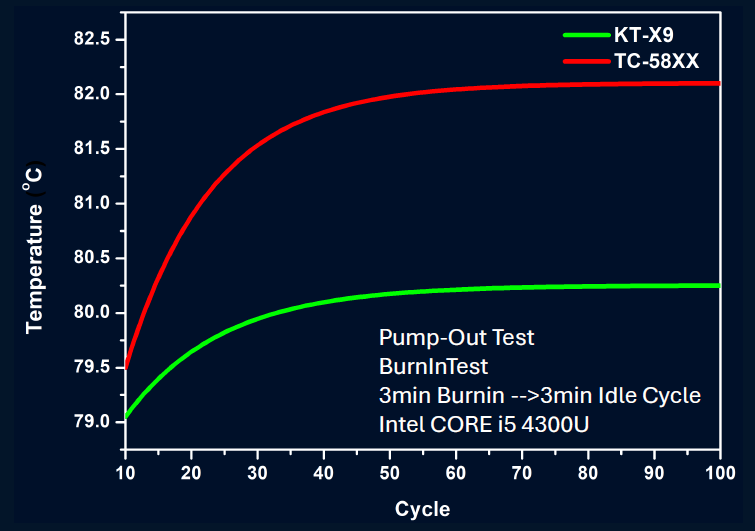
The original chart covers 100 cycles, with 3 minutes burn-in / 3 minutes idle, and identifies an Intel Core i5 4300U. It supports discussion of pump-out and temperature change.
Supplier chart labels are retained. Confirm the detailed setup and original report during technical evaluation.
Need the current TDS, SDS or a sample evaluation? Share your application and test requirements to discuss suitable grades and supply terms.
Tell us about your material requirements, operating conditions and validation goals.